For decades, UK businesses were built around fixed infrastructure. Desk phones, copper broadband connections, and on-site systems changed the way organisations communicated, traded, and operated their businesses. That model is now slowly being replaced by something much more flexible.
Across retail, logistics, professional services, healthcare, and manufacturing, operations are becoming:
- Location-agnostic
- Data-driven
- Increasingly automated
The networks supporting them must adapt accordingly. This is where full-fibre broadband and 5G connectivity are changing not just speed, but the structure of modern UK operations. Rather than replacing one technology with another, many organisations are now building fluid networks — connectivity models that combine fibre, mobile, cloud, and automation to support how work actually happens today.
Table of Contents
- Why Fixed Networks No Longer Match Modern Operations
- Full-Fibre as the Backbone of Digital Operations
- The Expanding Role of 5G in Business Connectivity
- From Redundancy to Resilience: Why Hybrid Networks Matter
- Cloud Telephony and the Decline of Fixed Phone Lines
- Automation and IoT: Why Network Design Now Matters More
- Cost Control in a Converged Connectivity Model
- Security and Compliance in Modern Networks
Why Fixed Networks No Longer Match Modern Operations?
Traditional fixed-line connectivity was designed for predictable, centralised environments. Today’s operations look very different. UK businesses increasingly rely on:
- Distributed teams and hybrid working
- Cloud-based platforms rather than on-premise systems
- Real-time data from multiple locations
- Mobile workflows rather than desk-bound processes
According to Ofcom, data usage on mobile networks has more than tripled over the past five years, while demand for business-grade fibre has accelerated as cloud adoption becomes standard. Fixed copper lines, originally designed for voice, struggle to meet these requirements reliably. This shift is not about abandoning fixed infrastructure altogether — it is about removing dependence on a single point of connectivity.
Full-Fibre as the Backbone of Digital Operations
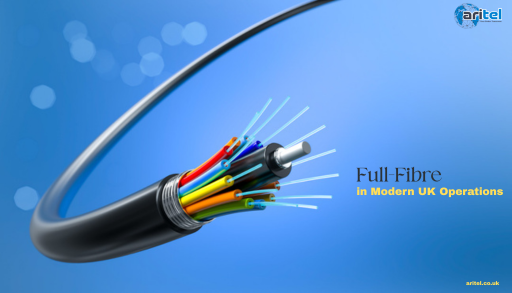
Full-fibre (FTTP) broadband provides the stability & capacity modern businesses require for core systems. Unlike copper-based services, fibre delivers consistent performance regardless of distance or demand peaks.
In the UK, FTTP broadband availability now exceeds 79% of premises, driven by national rollout programmes and private investment. For businesses, this has unlocked new operational possibilities.
What Full-Fibre Enables
- Reliable access to cloud platforms & SaaS tools
- High-quality VoIP phone systems for business use
- Stable connectivity for data-heavy applications
- Scalable bandwidth as operations grow
For many organisations, fibre now forms the primary connection supporting finance systems, customer platforms, inventory tools, and internal communications. However, fibre alone does not address every operational risk — particularly where mobility, resilience, or rapid deployment are required.
The Expanding Role of 5G in Business Connectivity
5G is often discussed in terms of speed, but its real value for UK businesses lies in flexibility & resilience. With improved latency, capacity, and coverage, 5G is increasingly used alongside fibre rather than as a replacement.
Practical Business Uses of 5G
- Backup connectivity during fibre outages
- Temporary or mobile site operations
- Supporting field-based teams and remote assets
- Enabling IoT-enabled monitoring and automation
UK mobile networks now cover over 96% of populated areas with 4G, with 5G coverage expanding rapidly across cities, transport hubs, and industrial zones. For businesses, this means mobile connectivity is no longer a compromise — it is part of the core infrastructure.
This shift has made business mobile solutions an operational necessity rather than a convenience.
From Redundancy to Resilience: Why Hybrid Networks Matter
Rather than choosing between fibre or mobile, many organisations are adopting hybrid connectivity models. A fluid network typically combines:
- Full-fibre broadband for primary operations
- 4G or 5G connectivity for backup and mobility
- Cloud-based phone systems instead of fixed PBX
- Centralised management across locations
This approach reduces downtime risk and enables businesses to continue operating even when a single connection fails. For sectors such as retail, healthcare, and logistics, where downtime directly affects revenue or safety, resilience has become a strategic priority.
Cloud Telephony and the Decline of Fixed Phone Lines
As networks evolve, voice services are evolving with them. Fixed analogue lines and on-site PBX telephone systems are increasingly replaced by cloud based phone systems for small businesses and enterprise environments alike.
Modern internet phone systems operate entirely over IP networks, allowing voice to move seamlessly between devices and locations.
Benefits of Cloud-Based Phone Systems
- No dependency on physical phone lines
- Consistent service across offices and remote staff
- Easier scaling without infrastructure upgrades
- Integration with CRM and collaboration tools
As the UK continues its transition away from legacy voice services, cloud telephony aligns naturally with fibre & mobile-first connectivity strategies.
Automation and IoT: Why Network Design Now Matters More
Connectivity is no longer just about access — it underpins automation and intelligent systems. Across UK industries, connected devices are being used to:
- Monitor energy usage and equipment health
- Automate inventory and supply chain processes
- Improve customer experience through real-time data
- Support predictive maintenance and analytics
These applications rely on consistent, low-latency networks. Fibre provides the throughput, while 5G enables deployment where wiring is impractical or too slow.
The rise of IoT means businesses must think beyond “internet access” and consider how data flows across sites, devices, and platforms in real time.
Cost Control in a Converged Connectivity Model
While advanced networks may sound expensive, fluid connectivity models can actually reduce long-term costs. Businesses that consolidate voice and data services, fixed and mobile connectivity, and multiple suppliers into fewer platforms often see lower operational overheads & simpler management.
Rather than maintaining separate contracts for broadband, telephony, and mobile, organisations increasingly look for business internet and phone solutions that work together. This reduces duplication, simplifies billing, and improves visibility over usage.
Security and Compliance in Modern Networks
As connectivity expands, so does the need for robust security. Modern fibre and mobile networks support:
- Encrypted data transmission
- Centralised monitoring and access control
- Faster deployment of security updates
- Improved resilience against service disruption
For UK businesses handling customer data or payment information, network design now plays a direct role in GDPR compliance and operational risk management. Legacy systems often lack the flexibility to adapt to evolving security standards, reinforcing the case for modern, IP-based infrastructure.
Final Thoughts
The move from fixed lines to fluid networks is not a trend — it reflects how businesses now operate. Organisations that adapt early benefit from:
- Greater operational flexibility
- Reduced downtime risk
- Better support for automation and growth
- Infrastructure that scales with demand
Those who delay often find themselves constrained by systems designed for a very different business environment.
The future of UK business connectivity is not defined by a single technology. It is shaped by how fibre, mobile networks, cloud platforms, and automation work together. From full-fibre broadband supporting core systems to 5G enabling mobility and resilience, fluid networks are becoming the foundation of modern operations. For organisations reviewing their connectivity strategy, the focus should move beyond speed and cost alone. It should be towards adaptability, reliability, and long-term suitability.
When the time comes to assess options or plan a transition, providers like Aritel Limited support UK businesses with connectivity solutions designed for modern operational demands — helping organisations move forward with confidence, not disruption.