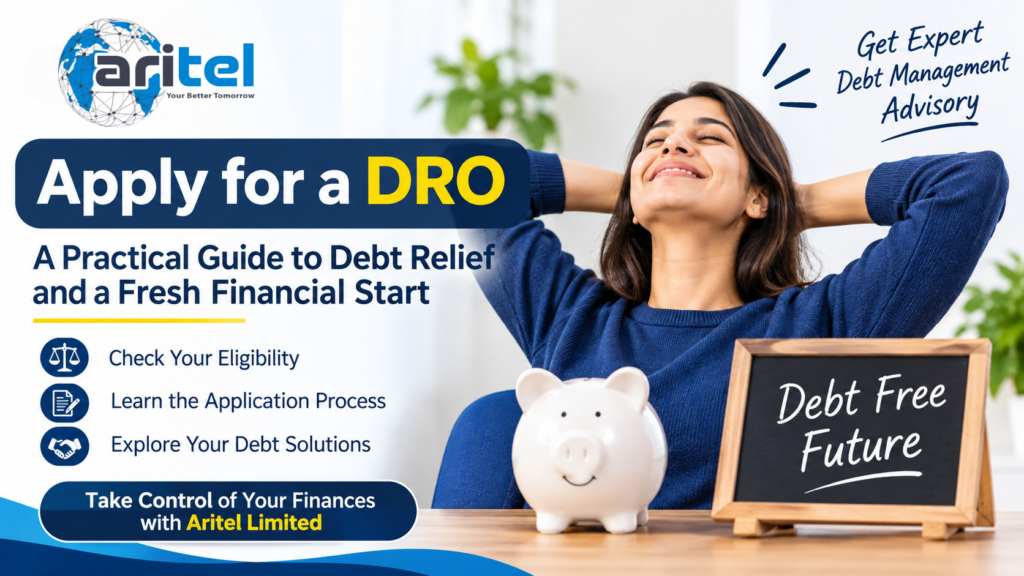
Managing multiple debts on a limited income can feel overwhelming. When monthly repayments, interest charges and outstanding balances become difficult to manage, finding the right debt solution is essential. A Debt Relief Order (DRO) could offer a way forward for eligible individuals who are struggling with unmanageable debts and have limited income and assets.
If you are looking to apply for a DRO in the UK, understanding the eligibility requirements, application process and potential benefits can help you make a more informed financial decision.
At Aritel Limited, we understand the challenges associated with financial difficulties. Our debt management advisory services aim to help individuals explore available debt solutions and take informed steps towards improving their financial circumstances.
What Is a Debt Relief Order (DRO)?
A Debt Relief Order (DRO) is a formal debt solution designed for people who cannot afford to repay their qualifying debts and have limited assets and disposable income.
A DRO is generally suitable for individuals with relatively low income, few valuable assets and no realistic ability to repay their outstanding debts.
Once a DRO is approved, it normally lasts for 12 months. During this period, you generally do not have to make payments towards the qualifying debts included in the order. If your circumstances do not change in a way that affects the order, these debts are usually written off at the end of the 12-month period.
A DRO can provide an opportunity to regain control of your finances and work towards a more stable financial future.
Who Can Apply for a Debt Relief Order in the UK?
Not everyone experiencing financial difficulties will qualify for a DRO. Applicants must meet specific eligibility conditions set by the UK Insolvency Service.
Generally, you may qualify if:
- Your total qualifying debts are less than £50,000.
- Your valuable assets are worth less than £2,000 in total.
- You do not own a vehicle worth £4,000 or more.
- You have no more than £75 per month in disposable income after allowable household expenses.
- You cannot afford to repay your debts.
- You have lived or worked in England or Wales within the last three years.
- You have not had a DRO within the previous six years.
- You are not currently subject to certain other formal insolvency arrangements.
Eligibility depends on your complete financial circumstances, and additional conditions may apply. A qualified debt adviser can assess whether a DRO is appropriate for your situation.
Why Should You Consider Applying for a DRO?
If you are struggling with debt repayments and have limited financial resources, a DRO may offer several advantages.
1. A Potential Fresh Financial Start
A successful DRO can provide relief from qualifying debts after the 12-month period, helping eligible individuals move towards a more manageable financial future.
2. Protection from Qualifying Debt Repayments
During the DRO period, creditors included in the order generally cannot demand payment or take enforcement action for those debts without the appropriate permission.
3. No Application Fee
There is currently no application fee for a DRO in England and Wales, making it an accessible formal debt solution for eligible individuals.
4. Reduced Financial Pressure
A DRO can help reduce the pressure of managing qualifying debt repayments, allowing you to focus on essential household expenses and financial stability.
5. An Opportunity to Rebuild Financial Confidence
With appropriate financial guidance and responsible money management, a DRO may help you take practical steps towards improving your long-term financial wellbeing.
How to Apply for a DRO: Step-by-Step Process
Applying for a Debt Relief Order involves several important stages. You cannot submit a DRO application independently; it must be completed through an approved intermediary.
Here is an overview of the process.
Step 1: Review Your Financial Situation
Start by understanding your current financial position. Make a list of your outstanding debts, monthly income, essential expenses, savings and valuable possessions.
Having a clear picture of your finances makes it easier to understand which debt solutions may be suitable.
Step 2: Check Your DRO Eligibility
Review the eligibility criteria, including your total qualifying debts, assets, vehicle value and disposable income.
An approved debt adviser can help assess whether you meet the necessary requirements.
Step 3: Speak to an Approved Debt Adviser
You must work with an approved intermediary to apply for a DRO. They will review your financial circumstances, explain the implications and determine whether a DRO is the right option.
Step 4: Prepare Your Financial Information
You may need to provide:
- Personal and contact information.
- Details of your employment and income.
- Monthly household expenses.
- Outstanding creditor balances.
- Bank accounts and savings information.
- Details of vehicles and other valuable assets.
- Information about relevant financial transactions.
Providing complete and accurate information is essential.
Step 5: Submit Your DRO Application
If you meet the eligibility requirements and decide to proceed, your approved intermediary will complete and submit the application to the Insolvency Service.
The Official Receiver will review your application and decide whether to approve, defer or refuse it.
Step 6: Follow the DRO Requirements
If your application is approved, you must follow the applicable restrictions throughout the DRO period.
You should also inform the Insolvency Service if your financial circumstances change, as this could affect your DRO.
What Happens After Your DRO Is Approved?
Once your Debt Relief Order is approved, you enter a 12-month period during which restrictions apply.
During this period:
- You generally stop making payments towards the qualifying debts included in your DRO.
- Creditors included in the order are generally prevented from pursuing payment.
- You must comply with the restrictions associated with your DRO.
- You must report relevant changes in your financial circumstances.
At the end of the 12-month period, qualifying debts covered by the DRO are generally discharged, provided the order has not been revoked or otherwise affected.
It is important to understand that a DRO can affect your financial opportunities. It normally remains on your credit file for six years from the approval date and may make obtaining credit more difficult.
Which Debts Can Be Included in a DRO?
A Debt Relief Order can cover several types of qualifying unsecured debts.
These may include:
- Credit card balances.
- Personal loans.
- Bank overdrafts.
- Utility bill arrears.
- Council tax arrears.
- Income tax debts.
- Buy Now, Pay Later debts.
- Certain benefit overpayments.
- Money owed to friends and family.
However, some debts cannot be included in a DRO, including student loans, child maintenance, certain court fines and secured debts.
You should seek professional advice to understand which of your outstanding debts may qualify.
Is a DRO the Right Debt Solution for You?
A DRO is not suitable for everyone. Depending on your income, assets, debt level and personal circumstances, other debt management solutions may be more appropriate.
Some alternatives worth exploring include:
- Debt Management Plan (DMP): An arrangement to make more affordable payments towards unsecured debts.
- Individual Voluntary Arrangement (IVA): A formal agreement with creditors to repay an agreed amount over a specified period.
- Bankruptcy: A formal insolvency procedure for individuals who cannot repay their debts.
- Breathing Space: A government scheme in England and Wales that can provide temporary protection from most creditor enforcement and interest while you receive debt advice.
Choosing the right solution requires a careful assessment of your financial circumstances and future commitments.
Get Professional Debt Management Guidance from Aritel Limited
Financial difficulties can affect more than your bank balance. They can create uncertainty, stress and concerns about your future.
At Aritel Limited, we believe that understanding your financial options is an important first step towards making informed decisions about debt management.
Our Debt Management Advisory service is designed to help individuals explore potential solutions for managing outstanding financial commitments and understanding the options available to them.
Whether you are considering applying for a DRO, exploring a Debt Management Plan or looking for guidance on managing multiple debts, taking the time to understand your options can make a meaningful difference.
Don’t let financial uncertainty hold you back. Explore your debt management options and take the first step towards a more confident financial future.